Small animals among the bottom
Aquatic insects, worms, snails and other invertebrates can be important foods. Younger fish often rely more heavily on small insects.
Sources: SRAC 180 · Channel Catfish: Life History and Biology
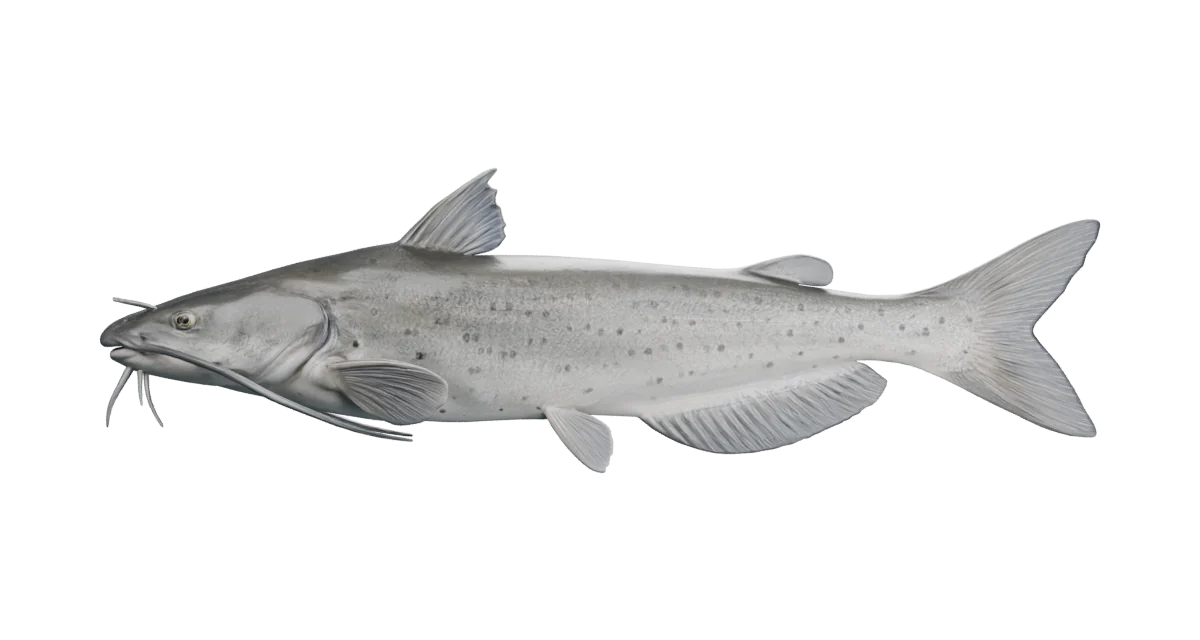
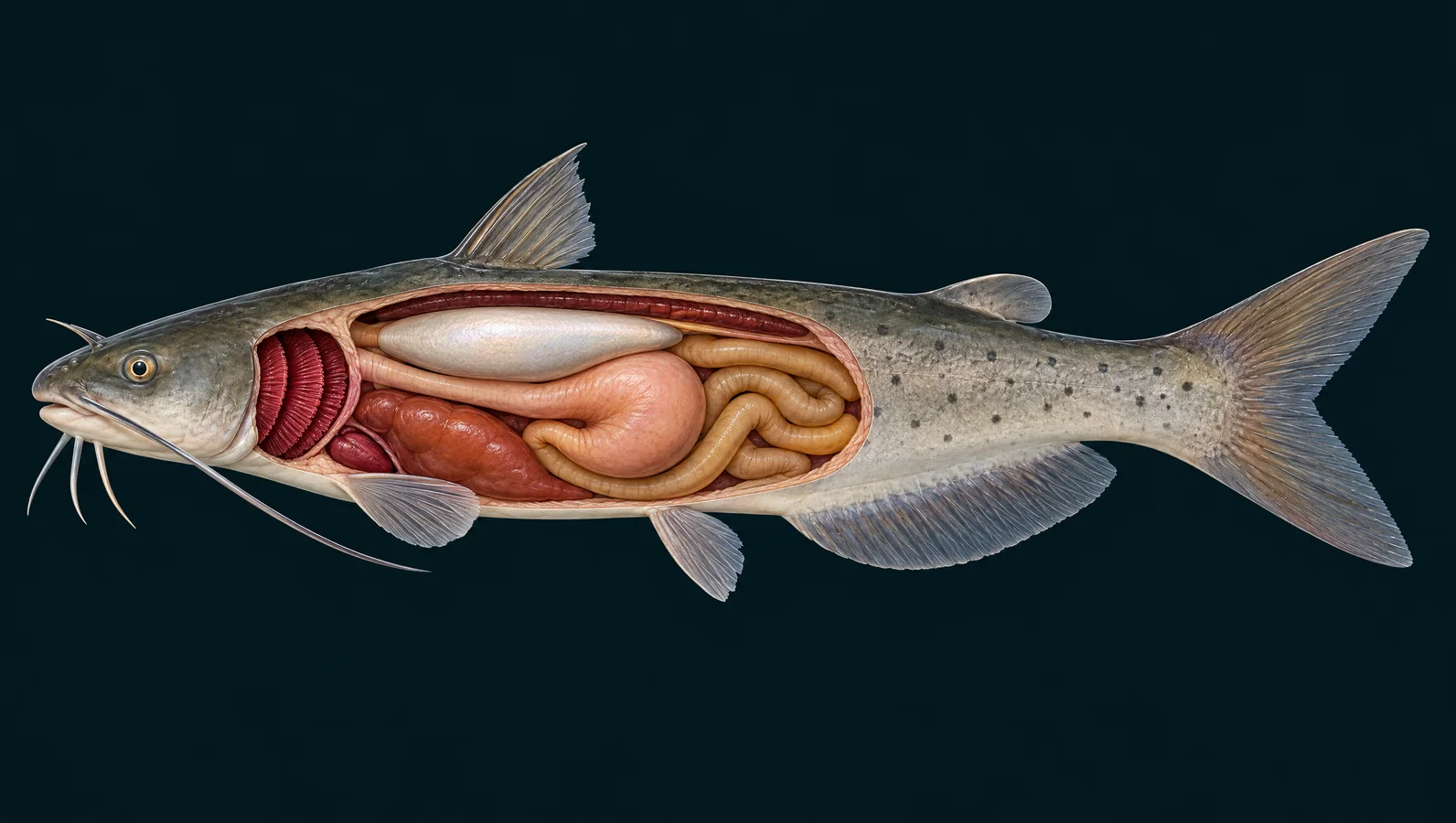
A fish that explores with its whole body. Follow the channel catfish's sensory barbels, forked tail and surprising connection between buoyancy and hearing, then trace a meal through its own distinctive digestive system.
New: four-step feeding animation. Follow food and water through the fish. Play, pause, or choose a step in the illustrated cutaway.
Fixed-side artist illustrations, not scans. Organ regions and skeletal details are simplified; independent expert review is pending.
The stages separate events for teaching; their timing can overlap in a real fish.
Barbels can touch a food item before the mouth expands to draw it in with water. This illustrates one documented sequence, not the only way a catfish feeds.
Sources: Olsen et al. (2019) · Channel catfish use higher coordination to capture prey than to swallow
Water crosses the gill region and exits behind the covers. Food remains in the mouth-and-throat region for further transport.
Sources: Olsen et al. (2019) · Channel catfish use higher coordination to capture prey than to swallow; SRAC 180 · Channel Catfish: Life History and Biology
Coordinated mouth and throat movements transport food into the esophagus and stomach. Swallowing is a separate stage from initial prey capture.
Sources: Olsen et al. (2019) · Channel catfish use higher coordination to capture prey than to swallow
The stomach begins chemical digestion; the looping intestine continues processing and absorbs nutrients. There is no pyloric-caeca cluster. Real digestion takes much longer than this demonstration.
Sources: Sis et al. (1979) · Microscopic anatomy of the channel catfish digestive tract; FAO · Digestion in teleost fishes, section 6.2; Fisheries and Oceans Canada archive · Channel catfish anatomical description
Aquatic insects, worms, snails and other invertebrates can be important foods. Younger fish often rely more heavily on small insects.
Sources: SRAC 180 · Channel Catfish: Life History and Biology
Larger catfish may eat crayfish, small fish, seeds and plant material. Diet changes with size and available food; this is not a fish-only predator.
Sources: Missouri Department of Conservation · Channel catfish; SRAC 180 · Channel Catfish: Life History and Biology
Channel catfish also take food above the bottom and sometimes at the surface. They can feed in daylight as well as after dark.
Sources: SRAC 180 · Channel Catfish: Life History and Biology
Back to species guide · Interactive controls become available when JavaScript loads. Read all explanations below.
Takes in food and respiratory water. Expansion of the mouth and throat pulls nearby water and food inward.
The broad mouth opens near the underside of the head; the lower jaw is shorter than the upper.
Sources: Olsen et al. (2019) · Channel catfish use higher coordination to capture prey than to swallow; Florida Museum · Channel catfish
Source-checked 2026-09-19. Independent anatomical review pending.
Detects light and visual detail. Channel catfish can use sight to locate food when water is clear.
Small eyes do not mean the fish is blind. Taste and touch become especially useful when visibility is poor.
Sources: SRAC 180 · Channel Catfish: Life History and Biology
Source-checked 2026-09-19. Independent anatomical review pending.
Admit water to smell-sensitive tissue. The nasal openings detect dissolved chemicals, separate from the breathing route through mouth and gills.
The marker indicates small openings ahead of the eye; the nearby nasal barbel is a different structure.
Sources: SRAC 180 · Channel Catfish: Life History and Biology; South Carolina DNR · Fish anatomy
Source-checked 2026-09-19. Independent anatomical review pending.
Sample food cues through taste and touch. These flexible whiskers carry taste receptors. They help the catfish investigate objects before taking them into its mouth.
There are four pairs around the head. Some partners are hidden in a side view.
Identification: Barbels are soft sensory structures. The stiff leading fin spines are the pointed structures to watch during handling.
Sources: SRAC 180 · Channel Catfish: Life History and Biology; The taste system of the channel catfish: from biophysics to behavior (1993); Florida Museum · Channel catfish
Source-checked 2026-09-19. Independent anatomical review pending.
Operculum
Protects the gills and helps move water. The movable cover encloses the gill chamber. Water exits behind its edge after passing the gills.
The smooth curved border behind the eye marks the cover, not the red gills beneath.
Sources: SRAC 180 · Channel Catfish: Life History and Biology
Source-checked 2026-09-19. Independent anatomical review pending.
Senses local water movements. Sensory cells in this system respond to motion of nearby water.
On this scaleless fish, the line is subtle. The highlight marks its broad course, not a sensory range.
Sources: South Carolina DNR · Fish anatomy
Source-checked 2026-09-19. Independent anatomical review pending.
Helps stabilize the body. The short rayed fin on the back has a stout leading spine and softer rays behind it.
It is separate from the fleshy adipose fin near the tail.
Sources: South Carolina DNR · Fish anatomy; Florida Museum · Channel catfish
Source-checked 2026-09-19. Independent anatomical review pending.
Help steer, brake and support the fish's position. The paired fins sit just behind the gill region; the first ray forms a strong spine.
The visible fin is the near-side partner. Its leading edge differs from the flexible rays following it.
Sources: South Carolina DNR · Fish anatomy; Kubicek (2022) · Developmental osteology of Ictalurus punctatus and Noturus gyrinus
Source-checked 2026-09-19. Independent anatomical review pending.
Stiffens the front edge of the pectoral fin. This modified fin ray resists bending. Its joint with the shoulder girdle is also involved in producing scraping sounds.
The barbel sweeping past this area is soft; this spine belongs to the fin.
On the water: Support the fish without pressing your hand against an erect dorsal or pectoral spine.
Sources: Kubicek (2022) · Developmental osteology of Ictalurus punctatus and Noturus gyrinus; Missouri Department of Conservation · Channel catfish; Fine et al. (1997) · Pectoral Spine Locking and Sound Production in the Channel Catfish Ictalurus punctatus
Source-checked 2026-09-19. Independent anatomical review pending.
Help balance and maneuver. This pair of belly fins contributes to control of the fish's position.
The pelvic fins are behind the pectoral pair, near the middle of the underside.
Sources: South Carolina DNR · Fish anatomy; Florida Museum · Channel catfish
Source-checked 2026-09-19. Independent anatomical review pending.
Contributes to stability while swimming. The long fin under the rear body works with the other median fins.
Its outer edge is gently rounded; this differs from the straighter anal-fin edge of a blue catfish.
Identification: Use the rounded anal edge with body pattern and tail shape. Fin-ray counts in this reconstruction are not a counting key.
Sources: Missouri Department of Conservation · Channel catfish; South Carolina DNR · Fish anatomy
Source-checked 2026-09-19. Independent anatomical review pending.
Caudal fin
Transfers body movement into thrust. Side-to-side body bends and tail sweeps push against water.
The deeply forked tail helps distinguish channel catfish from bullheads with squarer or rounded tails.
Sources: Missouri Department of Conservation · Channel catfish; South Carolina DNR · Fish anatomy
Source-checked 2026-09-19. Independent anatomical review pending.
A small fleshy fin on the rear back. This fin has no stiff spine or visible fin-ray fan.
Its presence is shared with several other fish groups and does not by itself identify a channel catfish.
Sources: South Carolina DNR · Fish anatomy; Florida Museum · Channel catfish
Source-checked 2026-09-19. Independent anatomical review pending.
Provides a protective living surface. Channel catfish have no scales. Skin and mucus form a barrier between body and surroundings.
Scattered dark spots often become less obvious in large adults.
On the water: Wet hands and gentle handling help protect the mucus covering.
Sources: Missouri Department of Conservation · Channel catfish; Kentucky State University · Live hauling channel catfish
Source-checked 2026-09-19. Independent anatomical review pending.
Filaments and lamellae
Exchange gases with water. Dissolved oxygen enters blood across thin gill surfaces while carbon dioxide moves out.
The illustration shows the gill region; tiny exchange surfaces are explained in the enlarged inset.
Sources: SRAC 180 · Channel Catfish: Life History and Biology
Source-checked 2026-09-19. Independent anatomical review pending.
Pumps blood toward the gills. Blood returns from the body, passes through the heart and travels to the gills before circulating through the body again.
This small organ is low and forward near the gill chamber, not in the middle of the abdomen.
Sources: SRAC 180 · Channel Catfish: Life History and Biology; Huchzermeyer · Introduction to anatomy and physiology of fish
Source-checked 2026-09-19. Independent anatomical review pending.
Moves swallowed food into the stomach. After capture, separate mouth and throat motions transport food backward. Water from the original gulp can leave through the gill openings.
Food transport is not simply the original suction strike played backward.
Sources: Olsen et al. (2019) · Channel catfish use higher coordination to capture prey than to swallow; FAO · Digestion in teleost fishes, section 6.2
Source-checked 2026-09-19. Independent anatomical review pending.
Processes absorbed nutrients and produces bile. Food stays in the digestive tube; the liver supports digestion and metabolism without food passing through it.
Its lobes occupy the front lower cavity. They are separated from the stomach in this teaching view.
Sources: Huchzermeyer · Introduction to anatomy and physiology of fish; FAO · Digestion in teleost fishes, section 6.2
Source-checked 2026-09-19. Independent anatomical review pending.
Stores a meal and begins chemical digestion. Channel catfish have a glandular stomach with a curved sac and a smaller outlet region.
Unlike trout, this species has no pyloric caeca. Its smooth outlet leads into intestine rather than a cluster of fingerlike pouches.
Sources: Sis et al. (1979) · Microscopic anatomy of the channel catfish digestive tract; FAO · Digestion in teleost fishes, section 6.2; Fisheries and Oceans Canada archive · Channel catfish anatomical description
Source-checked 2026-09-19. Independent anatomical review pending.
Continues digestion and absorbs nutrients. The intestinal tube loops around and behind the stomach before carrying remaining material toward the vent.
The gold loops are a simplified route; their position changes with fullness and specimen preparation.
Sources: Sis et al. (1979) · Microscopic anatomy of the channel catfish digestive tract; FAO · Digestion in teleost fishes, section 6.2
Source-checked 2026-09-19. Independent anatomical review pending.
Gas bladder
Contributes to buoyancy and hearing. The gas-filled bladder lies high and forward in the cavity. Channel catfish retain a duct between the bladder and digestive tract and can adjust their buoyancy.
Small Weberian bones link bladder vibrations with the inner ear. Those tiny bones are not individually resolved here.
Sources: Channel catfish swimming mode and buoyancy (2017); Ladich (2023) · Hearing in catfishes: 200 years of research; Huchzermeyer · Introduction to anatomy and physiology of fish
Source-checked 2026-09-19. Independent anatomical review pending.
Helps maintain water and salt balance. Kidney tissue filters blood and produces urine as part of internal regulation.
The dark strip lies along the roof of the cavity above the swim bladder; it is not shaped like a human kidney.
Sources: Huchzermeyer · Introduction to anatomy and physiology of fish; FAO · Digestion in teleost fishes, section 6.2
Source-checked 2026-09-19. Independent anatomical review pending.
Supports the head, senses and feeding structures. Many bones form the broad head. Movable connections contribute to opening and expanding the mouth region.
The tiny Weberian bones associated with hearing are not individually illustrated in this guide.
Sources: Kubicek (2022) · Developmental osteology of Ictalurus punctatus and Noturus gyrinus; University of Texas DigiMorph · Ictalurus punctatus, TNHC 30265
Source-checked 2026-09-19. Independent anatomical review pending.
Grasp food and help open the mouth. The oral jaws work with the deeper throat apparatus during capture and transport.
Catfish have fine tooth patches, rather than large isolated fangs. Those patches are not individually illustrated here.
Sources: Olsen et al. (2019) · Channel catfish use higher coordination to capture prey than to swallow; Kubicek (2022) · Developmental osteology of Ictalurus punctatus and Noturus gyrinus
Source-checked 2026-09-19. Independent anatomical review pending.
Spine
Supports the body while allowing bending. Segmented vertebrae form the central axis through which body muscles produce movement.
Anterior vertebrae are specialized in catfish. The cited developmental study distinguishes the modified front region from the abdominal and caudal series.
Sources: Kubicek (2022) · Developmental osteology of Ictalurus punctatus and Noturus gyrinus; University of Texas DigiMorph · Ictalurus punctatus, TNHC 30265
Source-checked 2026-09-19. Independent anatomical review pending.
Support the abdominal wall. Abdominal ribs angle backward and downward over the upper organ cavity. The tail region has a different arrangement of lower bony supports.
Behind the abdomen, longer hemal spines support the tail region and extend between the anal-fin supports. They are distinct from the abdominal ribs.
Sources: Kubicek (2022) · Developmental osteology of Ictalurus punctatus and Noturus gyrinus; University of Texas DigiMorph · Ictalurus punctatus, TNHC 30265
Source-checked 2026-09-19. Independent anatomical review pending.
Lepidotrichia
Support flexible fin surfaces. Segmented rays spread through the tail and other rayed fins; stout leading spines stiffen the dorsal and pectoral fins.
The adipose fin and barbels are soft tissues, without a comparable bony ray fan.
Sources: Kubicek (2022) · Developmental osteology of Ictalurus punctatus and Noturus gyrinus; South Carolina DNR · Fish anatomy
Source-checked 2026-09-19. Independent anatomical review pending.
Look beyond the whiskers. A forked tail, smooth spotted skin and rounded anal-fin edge help distinguish this species. Large adults may lose their obvious spots, so combine several features.
The body and tail produce thrust while other fins help control position. Catfish can also adjust buoyancy; their movement is more varied than simply resting on the bottom.
Water enters through the mouth and crosses delicate gill surfaces. Oxygen passes into the blood and carbon dioxide leaves it. Breathing continues between meals; feeding is not required to ventilate the gills.
Barbels help investigate a possible meal. Suction capture brings water and food inside; later throat movements carry retained food back. Water leaves through the gill openings while food enters the esophagus.
A broad skull, segmented backbone and fin supports lie beneath smooth skin. Leading dorsal and pectoral spines are stiff modified rays. Barbels stay soft and flexible.
Taste receptors occur on barbels and skin as well as inside the mouth. Eyes, nares and the lateral line add other information. These abilities do not prove that a particular bait will work.
The gas bladder sits high and toward the front, above part of the stomach. Small bones carry its vibrations toward the inner ear. Below it, stomach and intestine handle an omnivorous diet without trout-like pyloric caeca.
Connect whole-fish features with the species guide and Utah waters. Check dated records when investigating stocking; a species occurring at a lake does not establish that it was stocked recently.
A species listed in a water guide is not evidence of recent stocking. Compare the channel catfish fishing guide, Utah water guides, and dated stocking records.
Species identification, anal-fin outline, scaleless skin, spotting and feeding ecology. Regional regulations are not applied to Utah.
Species-specific external anatomy, barbels, fins and identification.
Senses, diet and respiration; figures 2–3 explain gill filaments, blood flow and countercurrent exchange. Numerical farming thresholds are not used.
Taste receptors on the body, barbels and within the mouth; biological sensing does not establish bait effectiveness.
XROMM measurements distinguish suction capture from subsequent food transport. Illustration timing is not fitted to measured strikes.
The published abstract describes the esophagus, glandular J-shaped stomach, pyloric region and intestine. Full article was not available in this evidence review; the no-caeca trait is corroborated separately by the DFO-hosted species description.
Channel catfish digestive arrangement and anterior/dorsal swim-bladder position. Reference artwork is not reproduced.
Physostomous gas bladder, gas regulation and swimming behavior. No measured hydrodynamic claim is made for the animation.
Swim bladder and Weberian apparatus in hearing, including channel-catfish experiments; no hearing range is visualized.
Species-specific cranial and postcranial skeleton, fin spines and modified anterior elements. Fine bone counts are not replicated.
Actual CT specimen supporting broad skeletal layout. No CT data or restricted artwork is incorporated in generated assets.
General fin functions, lateral line, nares and adipose-fin identification.
Protective mucus and salt balance; transport prescriptions are not provided by this exhibit.
General teleost circulation, liver function and kidney regulation. Trout examples are not evidence for catfish-specific geometry.
Source label CHANNEL CATFISH. Lake occurrence and actual dated stocking are different kinds of evidence.
Author-posted abstract supports sound production through contact between the pectoral spine process and cleithrum. Fine friction surfaces are not resolved in this exhibit.
Printed page 605 (PDF page 72), within the Ictalurus punctatus account beginning on PDF page 71, explicitly describes absence of pyloric caeca. Used only for this trait; historical bone counts are not transferred to the artwork.
Species-specific reference and internal/skeletal illustrations generated with Higgsfield GPT Image 2.5; exterior mesh generated with Meshy 7 through fal, September 2026. Model optimization, annotations and educational motion prepared for Utah Stocked Fish. Generated through connected provider accounts. No third-party Creative Commons license or expert endorsement is asserted.
Artistic exterior reconstruction and simplified fixed-side cutaways, not scans. Major organ regions are separated for clarity; gonads, vessels, fine bones and Weberian ossicles are not resolved. Counts and dimensions are not diagnostic. Flow paths and motion are explanatory, not measured kinematics. Biological text is source-checked; independent expert review of artwork and motion is pending. The skeleton illustration was withheld after the September 19 evidence review found incorrect axial and fin-support geometry. Bone explanations remain available; a corrected image needs anatomical review before release.